

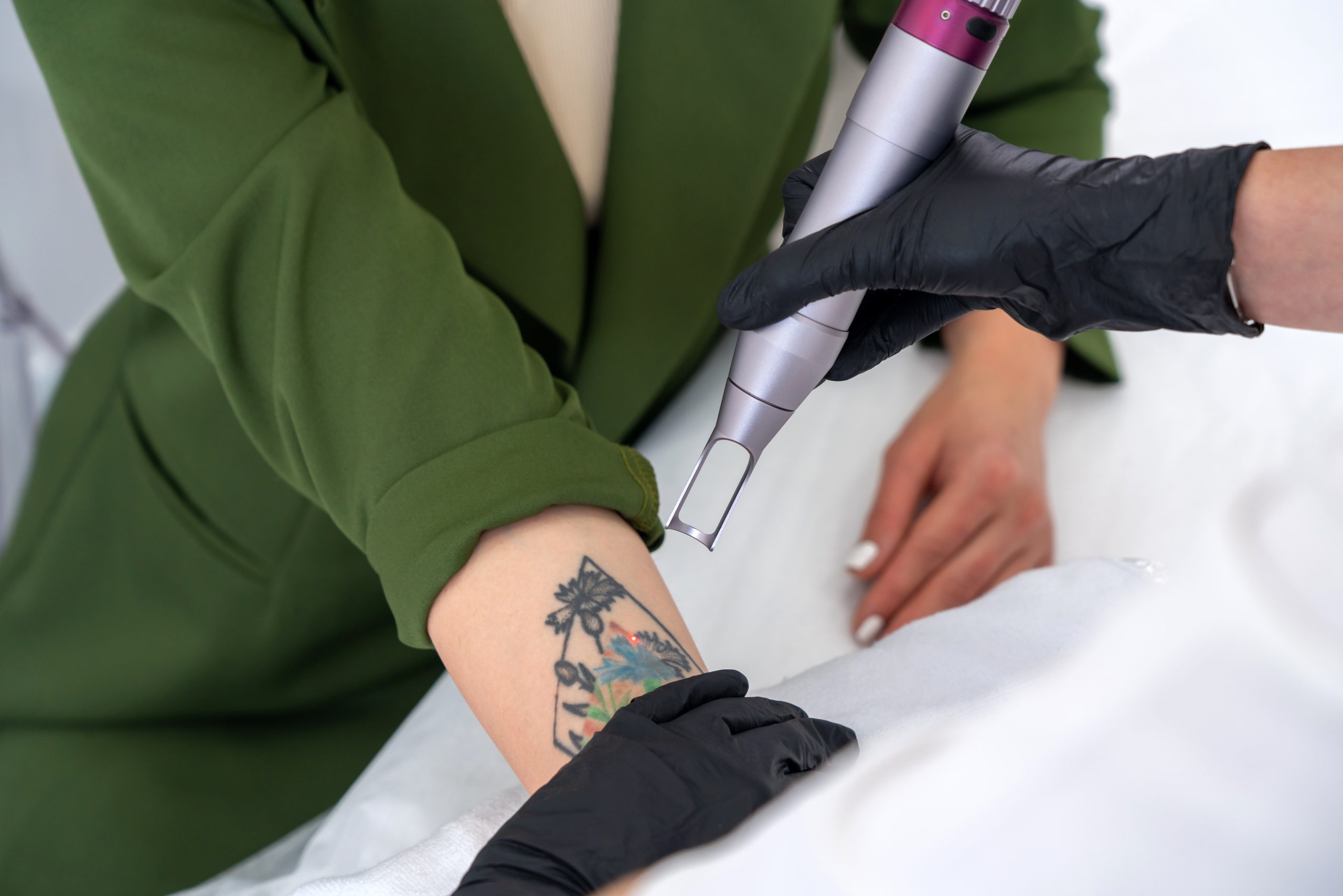
Yes, pico laser technology can remove color tattoos, making it a highly effective solution for fading and clearing a wide spectrum of tattoo colors. Unlike older laser technologies that struggle with vibrant inks, modern pico lasers deliver ultra-short pulses of energy that can shatter even stubborn color pigments.
At DermaLaser Medspa in Cumming, GA, we use the advanced Fotona StarWalker PQX system – a powerful pico laser that targets and clears a diverse range of ink colors, giving you a better chance of achieving clear, ink-free skin.
For years, tattoo removal was an unpredictable process, especially for colorful designs. The introduction of pico laser technology changed everything, offering a more efficient and effective method for clearing unwanted ink.
A pico laser delivers concentrated energy to the skin in extremely short bursts – we’re talking picoseconds, which are trillionths of a second. This incredible speed is the key to its effectiveness.
At DermaLaser Medspa, we use the Fotona StarWalker PQX, which combines the power of picosecond pulses with multiple wavelengths to address a wide range of pigmented lesions and skin concerns. This system is not only for tattoo removal but is also a premier solution for treating hyperpigmentation, melasma, and acne scars.
When a tattoo is created, ink particles are embedded deep within the dermis layer of your skin. Your body’s immune system recognizes these particles as foreign, but they are too large for your white blood cells to carry away.
A pico laser works by generating a photoacoustic effect. Its ultra-fast energy pulses create a powerful shockwave that shatters the large ink particles into tiny, dust-like fragments. These minuscule particles are now small enough for your body’s lymphatic system to naturally identify, process, and eliminate over the following weeks.
While modern technology has made significant strides, colorful tattoos present unique challenges. The difficulty lies in the basic physics of light and color.
Different colors absorb different wavelengths of light. Think of wearing a black shirt on a sunny day – it absorbs all wavelengths of light and gets hot. A white shirt reflects all wavelengths and stays cool.
Tattoo inks work similarly. A specific laser wavelength is needed to be absorbed by a specific ink color. If the ink doesn’t absorb the laser’s energy, it won’t shatter.
A laser’s wavelength (measured in nanometers or “nm”) determines which colors it can treat:
1064 nm: Ideal for black and dark blue inks. Penetrates deeply and is safest for darker skin tones
532 nm: Highly effective for red, orange, yellow, purple, and brown inks
650 nm: Targets green and teal inks
585 nm: Specifically targets sky blue and light blue inks
This is why single-wavelength lasers are often ineffective on multi-colored tattoos. The Fotona StarWalker PQX offers multiple wavelengths in one device, allowing us to switch settings during a single session.
The biggest challenges include:
Many clinics only have lasers with one or two wavelengths
Lighter colors like yellow, white, and fluorescent inks tend to reflect laser light
Mixed ink formulations can respond unpredictably
Modern inks may contain metallic compounds that resist treatment
Layered colors may reveal underlying inks as top layers are removed
Ink composition, density, and injection depth all play significant roles
The StarWalker PQX is engineered to overcome color removal challenges through its versatile technology.
The StarWalker PQX combines picosecond pulses with multiple wavelengths. During treatment, our providers analyze your tattoo colors and select appropriate wavelengths for each specific ink.
For example, we might start with 1064 nm for black outlines, then switch to 532 nm for red and orange sections. This ability to customize treatment on the fly makes the StarWalker PQX one of the most powerful tools for clearing complex, multi-colored tattoos.
Every tattoo is unique, but there are general rules for how different colors react to pico laser treatment.
Black is the easiest color to remove. It absorbs all laser wavelengths, making it highly responsive to 1064 nm settings. Most patients see significant fading early in their treatment series, often achieving substantial results after just 3-4 treatments.
These colors show excellent response to pico technology:
Dark blues respond well to 1064 nm wavelength
Greens are effectively targeted by a 650 nm wavelength
Most patients see substantial fading within 5-7 sessions
Pico technology is especially good at shattering these dense pigments
Red and its variations (orange, brown) are readily absorbed by a 532 nm wavelength. These colors typically fade well with 4-6 treatment sessions, though they may require slightly more sessions than black ink.
These lighter colors are traditionally the most challenging:
Yellow and orange require a 532 nm wavelength
Light green needs a 650 nm wavelength
May require 8-10 sessions
While pico lasers offer the chance of removal, complete clearance isn’t guaranteed
Purple is a mixed-pigment ink combining red and blue. Treatment requires multiple wavelengths – typically 532 nm and 1064 nm. Most purple tattoos show good clearance after 6-8 sessions.
Beyond color, several factors influence your tattoo removal outcome:
Tattoo Age and Ink Quality: Older tattoos often respond better because the body has already begun to break down the ink. Professional tattoos with dense, high-quality ink typically require more sessions than amateur tattoos
Skin Type and Color (Fitzpatrick Scale): Dark tattoos on fair skin are easiest to treat. We can safely treat all skin types, but darker tones require adjusted settings and potentially more sessions
Tattoo Size and Location: Larger tattoos need more time per session. Areas with good circulation (torso, neck, upper arms) fade faster than extremities (ankles, fingers)
Number of Sessions and Treatment Intervals: Most colored tattoos require 6-12 sessions for significant fading or complete removal. Sessions are spaced 6-8 weeks apart for healing and ink clearance
Your journey begins with an in-person consultation at our Cumming office. During treatment:
The area is cleaned thoroughly
Protective eyewear is provided
Topical numbing cream is applied if needed
The provider guides the laser handpiece over the tattoo
Cooling and protective ointment are applied post-treatment
Sessions last from a few minutes to half an hour, depending on the tattoo size.
Most patients describe the sensation as a rubber band snapping against the skin. The Fotona PQX’s ultra-short pulses minimize discomfort compared to older technologies. We use skin-cooling devices and topical numbing cream to maximize comfort.
Common temporary effects include:
White “frosting” that subsides within minutes
Redness and swelling (resolves within 24-48 hours)
Mild blistering (normal healing response)
Temporary tattoo darkening
Pinpoint bleeding (minimal with pico technology)
Proper aftercare is crucial:
Keep the area clean and dry for 24 hours
Apply antibiotic ointment as directed
Keep covered for the first few days
Avoid sun exposure and use SPF 50+ when outdoors
Don’t pick at scabs or blisters
Stay hydrated to support the lymphatic system
While pico laser technology has revolutionized tattoo removal, complete removal isn’t always possible for:
White and flesh-toned inks (may darken initially)
Certain metallic-based inks
Very dense, layered tattoos
Tattoos over scars
However, significant fading is achievable for most colored tattoos, often reaching 80-95% clearance. Some patients choose to stop treatment once the tattoo has faded enough for a cover-up design.
Pico laser technology has revolutionized the removal of colored tattoos, offering hope for those seeking to eliminate unwanted ink that was previously considered difficult or impossible to remove. At DermaLaser Medspa, our Fotona StarWalker PQX system combines multiple wavelengths with ultra-short pulse technology to effectively target the full spectrum of tattoo colors. While complete removal isn’t guaranteed for every color, most patients achieve significant fading that meets their goals. The journey requires patience and multiple sessions, but it provides the chance to restore your skin.

About the Author
Amit Sharma
May 30, 2026